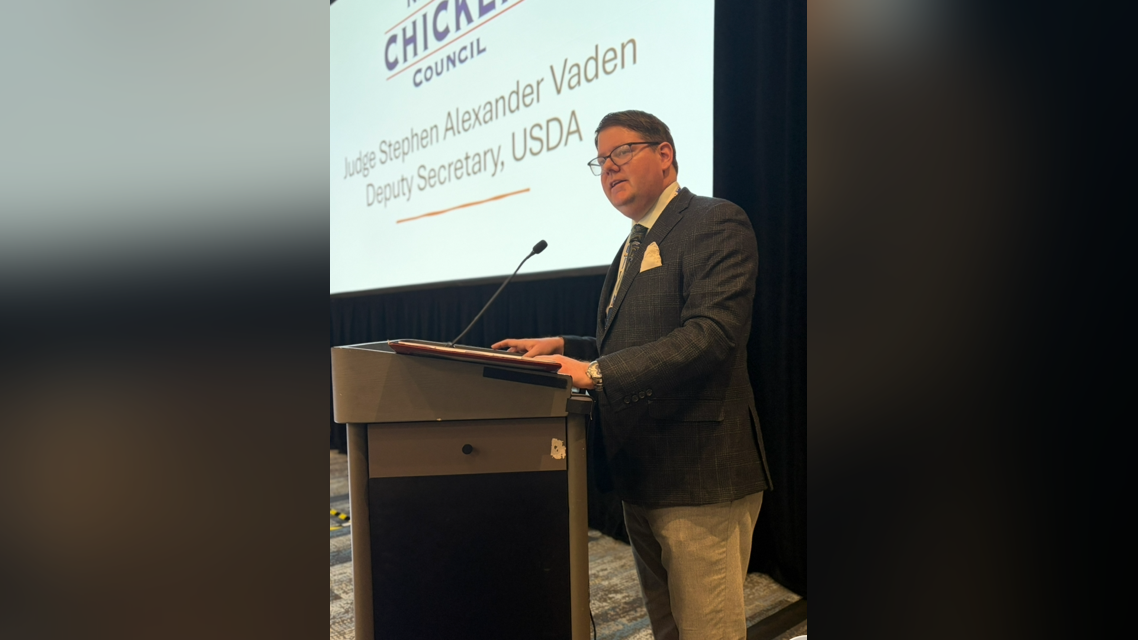
WHAT HAPPENED: NCC announced that Judge Stephen Alexander Vaden, USDA Deputy Secretary, will speak on October 29 at the National Chicken Council’s 71st Annual Conference in Washington, D.C.
ABOUT HIM: A native of rural Tennessee, Judge Vaden brings a lifelong connection to American agriculture and a deep understanding of the challenges facing the industry today. Before his appointment as Deputy Secretary, he served as General Counsel at USDA, where he helped implement the 2018 Farm Bill and successfully represented the Department in the U.S. Supreme Court. He later served as a judge on the U.S. Court of International Trade, where his work addressed key issues impacting global agricultural markets and U.S. exports. A graduate of Vanderbilt University and Yale Law School, Judge Vaden remains a strong advocate for policies that strengthen rural communities and ensure a stable, secure food supply.
WHAT HE’LL DISCUSS: Regulatory issues of importance to the broiler industry.
HOW TO REGISTER: Time is running out! Join NCC October 28–29, 2026, in Washington, D.C., to gain insights into the legislative, regulatory, political, business, and economic issues shaping the chicken industry’s future — and connect with industry leaders driving that future forward. The conference is open to NCC members, state association representatives, press, government officials, academia, and other interested parties. For more information, questions, sponsorship opportunities, or to register, please contact Polina Burko at [email protected].
THANKING OUR ANNUAL CONFERENCE SPONSORS:


| 
| 
| 
|

| 
| 
| 
|

| 
| 
| 
|

| 
|
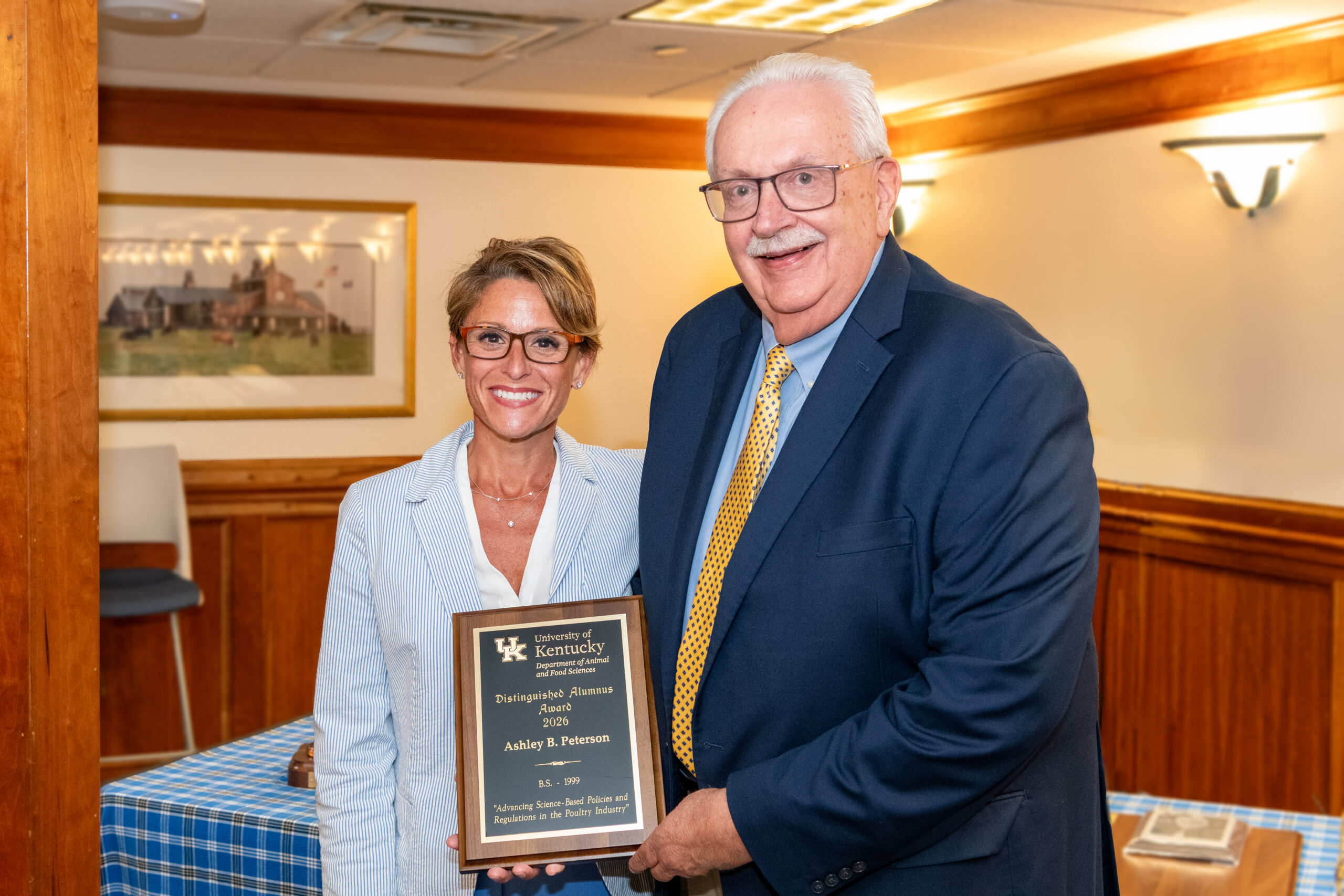
WHAT HAPPENED: At its Oct. 9, 2026 reunion celebration, the University of Kentucky Department of Animal and Food Sciences at the Martin-Gatton College of Agriculture, Food and Environment honored leaders whose careers have strengthened poultry production, policy, education and outreach.
THE AWARD: The annual reunion awards recognize alumni and department leaders whose professional achievements and service have made a lasting impact on animal agriculture, exemplifying the department’s commitment to science-based leadership and service to poultry producers in Kentucky and across the nation.
THE HONOREES: NCC’s Ashley Peterson, Ph.D., senior vice president of scientific and regulatory affairs, received the 2026 Animal and Food Sciences Distinguished Alumnus Award. A Shelby County native, Peterson earned a bachelor’s degree in animal science from UK in 1999 before completing graduate degrees at Michigan State University and the University of Maryland.
Anthony J. Pescatore, Ph.D., UK professor emeritus and longtime Extension poultry specialist, received the 2026 Animal and Food Sciences Hall of Fame Award. Pescatore nominated Peterson for the award.
WHAT THEY’RE SAYING: “Dr. Peterson brings the voice of science to the discussion of these complicated issues,” Pescatore wrote. “Industry leaders, politicians and government agencies turn to Ashley for information and facts on the most controversial issues facing the poultry industry.”
Jamie D. Guffey, executive director of the Kentucky Poultry Federation, echoed that sentiment. In a letter supporting Peterson’s nomination, Guffey wrote that his organization depends on Peterson’s communications to stay informed.
“Returning to the place that laid the foundation for my professional life underscores the influence that my mentors and experiences have had on my career,” Peterson said. “I am grateful for the opportunity to continue to serve such a critically important industry.”

WHAT HAPPENED: The National Provisioner’s “State of the Industry 2026” special report includes a chicken feature by NCC Senior Vice President of Communications Tom Super. The piece argues that chicken is well positioned to lead as protein becomes the organizing principle of how Americans eat.
WHY IT MATTERS: The article points to several trends working in chicken’s favor:
- Dietary guidance: The 2025-2030 Dietary Guidelines nearly double the recommended protein target and steer consumers toward nutrient-dense proteins. In NCC’s Chicken Marketing Summit survey, fielded by Circana, a net 40% of buyers say they are purchasing more fresh chicken in response.
- GLP-1 users: 27% of respondents say they or a household member have used a GLP-1 medication, up from 12% two years ago. Within that group, poultry consumption is up a net 7 points, while snacking, alcohol and eating out are declining.
- Ultra-processed foods: The piece outlines NCC’s concern that a federal UPF definition could mislead consumers by judging foods on how they are made rather than on their nutrient content.
- Policy: FSIS’s proposed rule to raise maximum line speeds to 175 birds per minute has cleared public comment. The HOT Rotisserie Chicken Act passed the House 384-35 as part of the Farm Bill and was included in the Senate Agriculture Committee’s version.
- Convenience: Fast prep time remains buyers’ top priority. More than half of chicken buyers now use AI tools for recipes, up from 28% a year ago.
READ THE FULL ARTICLE: Why Chicken Is Poised to Lead the ‘Protein Moment’
WHAT HAPPENED: USDA’s Economic Research Service (ERS) released a report recently, Signaling Food Safety: Pathogen Rates of Raw Poultry With Food Safety Certifications (ERR-362). It examines whether third-party food safety certifications are associated with lower pathogen rates in raw poultry. The certifications studied are SQF, BRCGS and FSSC 22000, all recognized by the Global Food Safety Initiative (GFSI).
WHAT IT LOOKED AT: The researchers analyzed FSIS raw poultry sampling data from 592 establishments collected between October 2023 and March 2024. That covered 13,837 Salmonella tests and 7,519 Campylobacter tests across chicken carcasses, chicken parts, ground chicken and turkey products. About 73% of samples came from certified establishments.
KEY FINDINGS:
- Salmonella: Products from certified establishments were about 4 to 6 percentage points less likely to test positive than products from uncertified establishments. The overall positive rate across all samples was 8.4%.
- Campylobacter: Results were mixed and inconclusive. Only FSSC 22000 showed a statistically significant reduction, and that finding rests on just two establishments and 22 samples. The overall positive rate was 18%.
- By product and plant size: Though marginal, the more notable Salmonella reductions occurred in whole chicken carcasses (about 8%) and at very small and small establishments (about 7%).
LIMITATIONS: The authors conclude that certified poultry products are at least as safe as uncertified products. Certification was consistently associated with lower Salmonella rates, but its link to lower Campylobacter rates was inconsistent so no conclusions were drawn. They note that GFSI benchmarks do not set product pathogen targets, and they suggest stronger pathogen-related standards could help certifications signal risk reduction more clearly. The authors also caution that the study shows correlation, not causation. It draws on only six months of data, and establishments that choose to get certified may differ from others in ways the data can’t capture.
U.S. total broiler slaughter data for the week ending October 10, 2026, is estimated by USDA’s Poultry Market News Service to be 172,328,000 broilers, no change from the same week a year earlier.
The no change in slaughter compares with a 1-percent increase in eggs set in the United States 10 weeks earlier, and a 1-percent increase in chicks placed 7 weeks earlier in the United States. USDA’s latest Broiler Hatchery report can be viewed here.
| U.S. Eggs Set, Chicks Placed, Broiler Slaughter Report | ||||||||||
| Week ending | Eggs set | Chicks placed | Eggs set | Chicks placed | Broilers slaughtered | |||||
| change from | change from | 10 weeks previous | 7 weeks previous | |||||||
| 1 year | 1 year | 1 year | 1 year | 1 year | ||||||
| -000- | % | -000- | % | -000- | % | -000- | % | -000- | % | |
| Sep | ||||||||||
| 5 * | 248,652 | 99 | 193,413 | 100 |
252,451 | 101 | 195,455 | 101 | 174,775 | 108 |
| 12 | 244,017 | 99 | 195,227 | 101 |
251,737 | 100 | 194,607 | 100 | 158,906 | 91 |
| 19 | 244,999 | 102 | 194,508 | 100 |
251,893 | 102 | 194,575 | 101 | 168,013 | 96 |
| 26 | 249,606 | 103 | 193,261 | 99 |
252,493 | 101 | 195,784 | 101 | 172,874 | 99 |
| Oct | ||||||||||
| 3 | 245,519 | 101 | 189,140 | 98 |
253,586 | 102 | 196,464 | 102 | 170,627 | 98 |
| 10 ** | 245,304 | 102 | 190,295 | 103 |
252,434 | 101 | 195,176 | 101 | 172,328 | 100 |
| 17 | — | — | — | — |
250,870 | 101 | 194,483 | 101 | — | — |
*Labor Day Holiday Weekend
**Columbus Day Holiday Weekend