
WHAT HAPPENED: NCC announced that Dylan Daniels, Assistant United States Trade Representative for Agricultural Affairs and Commodity Policy, will speak on October 29 at the National Chicken Council’s 71st Annual Conference in Washington, D.C.
ABOUT HIM: Daniels brings extensive experience in international trade and agricultural policy, having held senior positions with the Office of the United States Trade Representative, the U.S. Department of Agriculture, and the Department of Commerce. He returns to USTR from the USDA’s Foreign Agricultural Service (FAS) where he served as Senior Policy Advisor, Licensing Official for the Dairy and Sugar import programs, and the Designated Federal Official for the Sweeteners Agricultural Trade Advisory Committee.
Daniels began his career in trade as an international economist with FAS. He worked as a senior trade specialist for the International Trade Administration of U.S. Department of Commerce in Memphis Tennessee, then as a Senior Economist and Director with the Office of the United States Trade Representative in the Office of Agricultural Affairs and the Office of Trade Policy and Economics.
He is a Marine Corps Veteran and has a Jurist Doctor from the University of Florida Levin College of Law and a Master’s in Applied Economics from the University of Utah.
WHAT HE’LL DISCUSS: International trade and export issues of importance to the broiler industry.
HOW TO REGISTER: Time is running out! Join NCC next week October 28–29, 2026, in Washington, D.C., to gain insights into the legislative, regulatory, political, business, and economic issues shaping the chicken industry’s future — and connect with industry leaders driving that future forward. The conference is open to NCC members, state association representatives, press, government officials, academia, and other interested parties. For more information, questions, sponsorship opportunities, or to register, please contact Polina Burko at [email protected].

















WHAT HAPPENED: Brazil confirmed Newcastle disease on a commercial turkey farm of about 6,000 birds in western Santa Catarina. The lab confirmation came October 18, from samples taken September 21. Under its sanitary protocol with China, Brazil has stopped all poultry shipments to its biggest buyer. Mexico also moved quickly to suspend imports.
WHY IT MATTERS: Brazil is the main competitor for U.S. chicken exports. China took about 10% of Brazil’s poultry exports from January through September, roughly 420,000 MT. Santa Catarina accounts for about 23% of Brazil’s chicken exports, so a state-wide restriction would have a bigger effect than a local one.
WHAT’S NEXT: Analysts expect a short disruption. The last outbreak, in July 2024, cut Brazil’s chicken exports about 25% for the affected month, but they recovered quickly once markets reopened. JPMorgan said it expects an even smaller impact this time, because several countries now restrict trade by radius rather than nationwide.
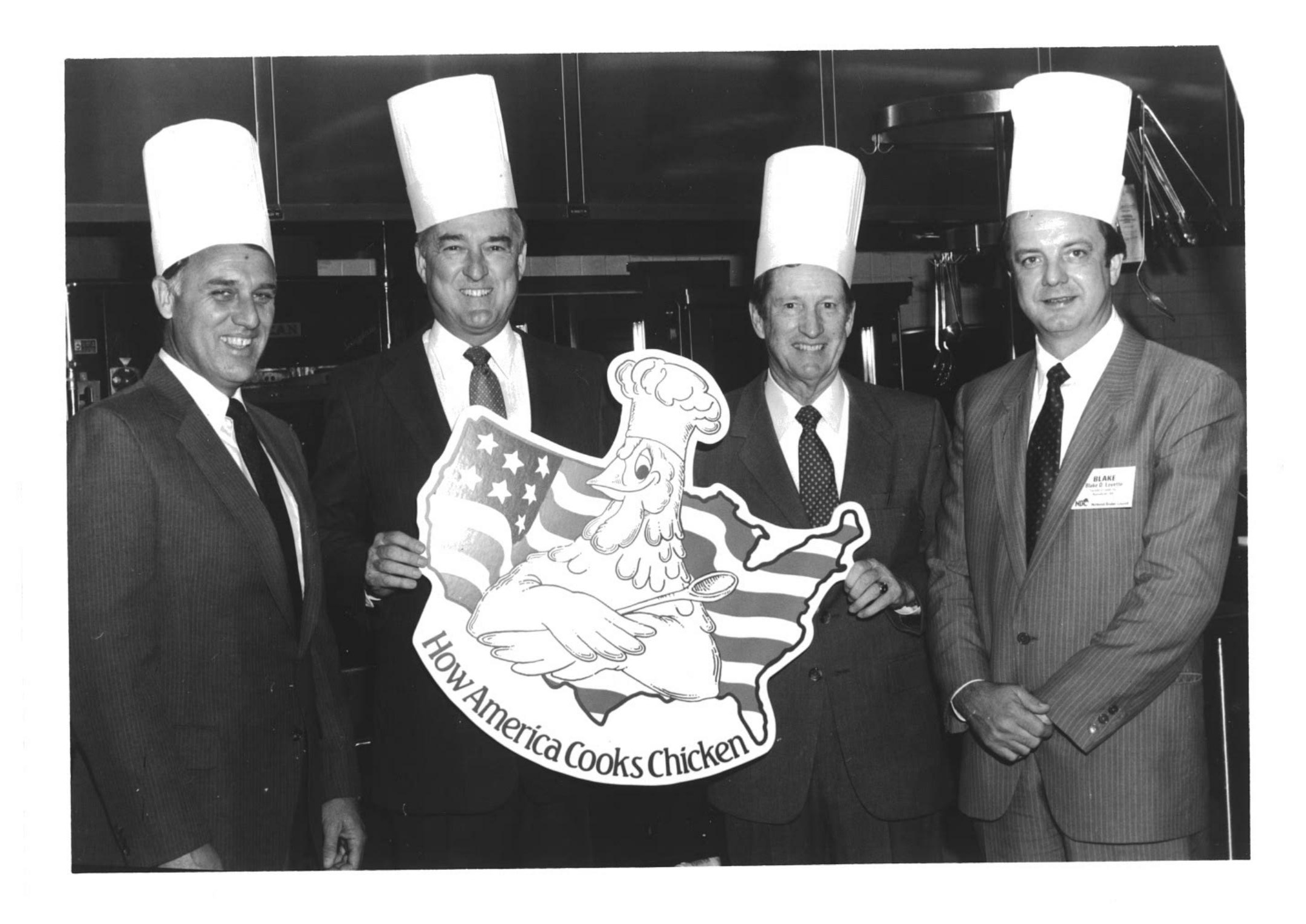
A scene from NCC’s Annual Conference in 1984 honoring the sponsor of that year’s Food Media Seminar, Elanco. Pictured from the left are Ron McGhee and Bob Howerton from Elanco; next James T. (Red) Hudson of Hudson Foods and NCC Chairman; and Blake Lovette, of Valmac Industries/Perdue at the time and incoming NCC Chairman. The chef’s hats were borrowed from the hotel.
U.S. total broiler slaughter data for the week ending October 17, 2026, is estimated by USDA’s Poultry Market News Service to be 172,933,000 broilers, no change from the same week a year earlier.
The no change in slaughter compares with a 1-percent increase in eggs set in the United States 10 weeks earlier, and a 1-percent increase in chicks placed 7 weeks earlier in the United States. USDA’s latest Broiler Hatchery report can be viewed here.
| U.S. Eggs Set, Chicks Placed, Broiler Slaughter Report | ||||||||||
| Week ending | Eggs set | Chicks placed | Eggs set | Chicks placed | Broilers slaughtered | |||||
| change from | change from | 10 weeks previous | 7 weeks previous | |||||||
| 1 year | 1 year | 1 year | 1 year | 1 year | ||||||
| -000- | % | -000- | % | -000- | % | -000- | % | -000- | % | |
| Sep | ||||||||||
| 12 | 244,017 | 99 | 195,127 | 100 |
251,737 | 100 | 194,607 | 100 | 158,906 | 91 |
| 19 | 244,999 | 102 | 194,508 | 100 |
251,893 | 102 | 194,575 | 101 | 168,013 | 96 |
| 26 | 248,423 | 102 | 193,261 | 99 |
252,493 | 101 | 195,784 | 101 | 172,874 | 99 |
| Oct | ||||||||||
| 3 | 245,445 | 101 | 189,438 | 98 |
253,586 | 102 | 196,464 | 102 | 170,627 | 98 |
| 10 * | 244,881 | 102 | 190,804 | 103 |
252,434 | 101 | 195,176 | 101 | 172,328 | 100 |
| 17 | 245,764 | 103 | 193,298 | 102 |
250,870 | 101 | 194,483 | 101 | 172,933 | 100 |
| 22 | — | — | — | — |
249,495 | 100 | 193,413 | 100 | — | — |
*Columbus Day Holiday Weekend