U.S. total broiler slaughter data for the week ending May 23, 2026, is estimated by USDA’s Poultry Market News Service to be 174,103,000 broilers, a 1-percent increase from the same week a year earlier.
The 1-percent increase in slaughter compares with a 2-percent increase in eggs set in the United States, 10 weeks earlier, and a 3-percent increase in chicks placed 7 weeks earlier in the United States. USDA’s latest Broiler Hatchery report can be viewed here.
| U.S. Eggs Set, Chicks Placed, Broiler Slaughter Report | ||||||||||
| Week ending | Eggs set | Chicks placed | Eggs set | Chicks placed | Broilers slaughtered | |||||
| change from | change from | 10 weeks previous | 7 weeks previous | |||||||
| 1 year | 1 year | 1 year | 1 year | 1 year | ||||||
| -000- | % | -000- | % | -000- | % | -000- | % | -000- | % | |
| Apr | ||||||||||
| 18 | 256,143 | 102 | 198,480 | 104 |
254,036 | 102 | 193,098 | 101 | 168,744 | 103 |
| 25 | 256,545 | 102 | 195,753 | 102 |
254,580 | 102 | 195,286 | 102 | 170,854 | 103 |
| May | ||||||||||
| 2 | 256,910 | 103 | 198,686 | 104 |
254,948 | 102 | 196,241 | 102 | 171,230 | 103 |
| 9 | 255,922 | 102 | 198,076 | 103 |
254,423 | 102 | 196,001 | 102 | 171,765 | 102 |
| 16 | 255,778 | 102 | 198,363 | 102 |
253,644 | 102 | 195,765 | 102 | 170,711 | 101 |
| 23* | 255,715 | 102 | 198,416 | 103 |
253,754 | 102 | 196,663 | 103 | 174,103 | 101 |
| 30 | — | — | — | — |
255,241 | 103 | 197,285 | 100 | — | — |
*Memorial Day Weekend
Two past chairmen of the National Broiler Council board received special awards recognizing their service to NBC and the broiler industry at the 23rd annual NBC conference in Washington (December, 1977). Incumbent chairman Edward Covell (L) presented the awards to Jess Merkle (C), who retired from the presidency of J-M Poultry Packing Company (and then Country Pride Foods) in El Dorado, Ark., and Ed Reynolds (R) who retired from his position as corporate vice president of Cargill in Minneapolis. 
WHAT HAPPENED: USDA’s Animal and Plant Health Inspection Service (APHIS) has updated its China export restrictions webpage to reflect that China has lifted HPAI-related poultry export restrictions for 17 states, effective May 15, 2026. The states are Alabama, Alaska, Arizona, Kentucky, Massachusetts, Nebraska, Nevada, New Hampshire, New Mexico, Ohio, Oklahoma, Oregon, Tennessee, Texas, Utah, Virginia, and West Virginia. Only products produced on or after May 15, 2026 are eligible for export to China from these states.
BACKGROUND: China had been blocking raw poultry imports from U.S. states affected by HPAI outbreaks. Under a Regionalization Agreement, HPAI restrictions by state are meant to be lifted 90 days after cleaning and disinfection, but China had not been abiding by that provision.
THE 2020 REGIONALIZATION AGREEMENT: It has been reported that APHIS has confirmed that China has agreed to resume the terms of the 2020 Regionalization Agreement. Under that framework, APHIS may submit state closeout reports 90 days after cleaning and disinfection is completed, and China then has 5 days to review and lift restrictions as applicable — providing a more timely and predictable path to restoring access.
WHAT’S NEXT: Twenty-seven states remain under restriction by China. The key broiler-producing states of Georgia, Mississippi, and Missouri have all recently reached the 90-day post-cleaning and disinfection milestone, meaning APHIS closeout reports for those states could be expected soon.
NCC’s TAKE: “China is a major market for U.S. chicken, especially paws, and the lifting of export restrictions and the reinstatement of the regionalization framework is a significant development,” said NCC President Harrison Kircher. “I want to thank the Trump administration, USTR and APHIS in particular, for their work in holding China to the terms it agreed to. Restoration of access would have a meaningful impact on export volumes of American chicken.”

Source: Magnific
WHAT HAPPENED: President Trump and EPA Administrator Lee Zeldin announced two actions on a final rule revising the Biden-era 2023 Technology Transitions Rule and a proposed technical fix to the 2024 Emissions Reduction and Reclamation (ER&R) Rule, both of which address costly restrictions on the types of refrigerants American businesses and families can use.
WHO IT AFFECTS: The actions would affect grocers, semiconductor manufacturers and other companies that use hydrofluorocarbons (HFCs), greenhouse gases used in refrigeration and air conditioning systems.
WHAT’S IN THE RULES: The final revisions to the 2023 Technology Transitions Rule extend compliance deadlines for the use of hydrofluorocarbons (HFCs), making a wider variety of refrigerants available to businesses while still meeting statutory requirements. EPA is also proposing to exempt all road refrigerant transport appliances from HFC leak repair requirements established in the 2024 ER&R Rule, removing burdens for owners and major U.S. operators of these appliances.
WILL IT REDUCE COSTS: According to a White House Fact Sheet, changes to the Technology Transitions Rule are estimated to save Americans over $900 million, including over $800 million at the supermarket level, and will safeguard over 350,000 high-skilled American jobs. Changes to the Emissions Reduction and Reclamation Rule could save transporters of refrigerated goods, including food, up to $1.5 billion.
WHAT THEY’RE SAYING: “Americans were right to be frustrated with the Biden-era refrigerant rules. They didn’t protect human health or the environment and instead piled on costly, unattainable restrictions beyond what the law requires,” said EPA Administrator Zeldin.

EPA Commissioner Lee Zeldin. Source: ABC News
WHAT’S NEXT: EPA has indicated it will also be reconsidering the remainder of the 2024 ER&R Rule in the future.
WHAT HAPPENED: The Circular Action Alliance (CAA), the designated producer responsibility organization (PRO) for six of the seven states with enacted Extended Producer Responsibility (EPR) packaging laws, has set a supply report deadline of May 31, 2026 — effectively June 1 since May 31 falls on a Sunday — for obligated producers. Chicken processors and other food industry producers that sell packaged products into California, Colorado, Oregon, Maryland, Minnesota, or Washington may be subject to these requirements.
BACKGROUND: EPR laws require companies — including brand owners, manufacturers, and licensees — to register with a PRO, report the weight of “covered materials” (generally single-use packaging, food service ware, and in some states paper products) sold into each state, and pay fees to the PRO.
WHAT’S DUE: Requirements vary by state. Producers in California, Colorado, and Oregon must file annual supply reports covering calendar year 2025 packaging data by material category. Producers in Maryland, Minnesota, and Washington must submit simplified “interim” supply reports for 2025. California producers face additional obligations, including a baseline plastic packaging report for 2023, an annual source reduction report, and — for those seeking a “small producer” exemption (under $1 million in gross California sales) — an exemption application, all due June 1. California producers also have an Individual Source Reduction Plan due August 1, 2026.
WHY IT MATTERS FOR THE CHICKEN INDUSTRY: Chicken companies that sell products in retail or food service packaging in any of these six states should assess whether they qualify as an “obligated producer” under each state’s law. Missing the reporting deadline could expose companies to compliance risk as state EPR programs move from planning into active enforcement phases.
The White House congressional picnic on Tuesday featured a “boardwalk buffet” of herb roasted chicken, short ribs and salmon. The White House posted video of President Trump and First Lady Melania Trump welcoming the members of Congress.

Source: CNN reporter Alejandra Jaramillo on X
U.S. total broiler slaughter data for the week ending May 16, 2026, is estimated by USDA’s Poultry Market News Service to be 170,711,000 broilers, a 1-percent increase from the same week a year earlier.
The 1-percent increase in slaughter compares with a 2-percent increase in eggs set in the United States, 10 weeks earlier, and a 2-percent increase in chicks placed 7 weeks earlier in the United States. USDA’s latest Broiler Hatchery report can be viewed here.
| U.S. Eggs Set, Chicks Placed, Broiler Slaughter Report | ||||||||||
| Week ending | Eggs set | Chicks placed | Eggs set | Chicks placed | Broilers slaughtered | |||||
| change from | change from | 10 weeks previous | 7 weeks previous | |||||||
| 1 year | 1 year | 1 year | 1 year | 1 year | ||||||
| -000- | % | -000- | % | -000- | % | -000- | % | -000- | % | |
| Apr | ||||||||||
| 11 | 256,827 | 103 | 197,285 | 103 |
251,111 | 101 | 192,408 | 101 | 171,173 | 102 |
| 18 | 256,874 | 102 | 198,480 | 104 |
254,036 | 102 | 193,098 | 101 | 168,744 | 103 |
| 25 | 256,431 | 103 | 195,753 | 102 |
254,580 | 102 | 195,286 | 102 | 170,854 | 103 |
| May | ||||||||||
| 2 | 256,491 | 102 | 198,686 | 103 |
254,948 | 102 | 196,241 | 102 | 171,230 | 103 |
| 9 | 256,101 | 103 | 198,636 | 103 |
254,423 | 102 | 196,001 | 102 | 171,765 | 102 |
| 16 | 255,513 | 102 | 198,107 | 103 |
253,644 | 102 | 195,765 | 102 | 170,711 | 101 |
| 23* | — | — | — | — |
253,754 | 102 | 196,663 | 103 | — | — |
*Memorial Day Weekend
This Memorial Day weekend, NCC honors America’s military men and women who lost their lives in service to our country. We will never forget their sacrifices to ensure the United States remains the land of the free.

WHAT HAPPENED: The House on Wednesday passed a bill, by a 218-203 vote, to allow year-round sales of higher ethanol blends, known as E15. The measure garnered support from 122 Republicans, 95 Democrats and one independent. The biofuel bill was rejected by 90 GOP members and 113 Democrats. A total of nine lawmakers didn’t vote.
BACKGROUND: Sales of E15, a fuel blend with 15 percent ethanol and 85 percent gasoline, have been typically restricted for parts of the year because of smog concerns, though President Trump has used executive action to allow E15 sales this summer.
THE MAIN STICKING POINT: The objections center around the economic ripple effects of language that would change how the Environmental Protection Agency handles small refinery exemptions (SREs) from national biofuel-blending rules under the Renewable Fuel Standard. The SRE provision also faces objection from independent refiners who say it would lead to burdensome compliance costs and put union jobs at risk.
WHAT’S NEXT: The bill faces some stiff opposition in the Senate. Some Republican senators from oil-producing states have vowed to oppose the bill, underscoring the challenges it faces in the upper chamber, where legislation must meet a 60-vote threshold to advance.
WHAT THEY’RE SAYING: “I oppose a year-round E15 mandate. That’s what’s currently under debate,” said Sen. John Barasso (R-WY). “I oppose it because it hurts small refineries and all of the people around the country who work in these small refineries.”
“In truth, ‘E15,’ as it is known, is the ethanol lobby’s Trojan horse to expand one of the most costly and destructive federal mandates in U.S. history: the Renewable Fuel Standard. Without reforms to the underlying rule, the E15 expansion entrenches a hidden gas tax, drives up food and fuel prices, slashes vehicle efficiency, threatens refining jobs, and undermines American energy dominance.” — Reps. Scott Perry (R-PA) and Chip Roy (R-TX) in a recent op-ed.

Source: Good in Every Grain
WHAT HAPPENED: Nothing yet. Registration is open for the 2026 Chicken Marketing Summit, scheduled for July 27-29 at Innisbrook Resort in Palm Harbor, Florida. But early bird rates — offering savings of $200 per registrant — end on May 31.
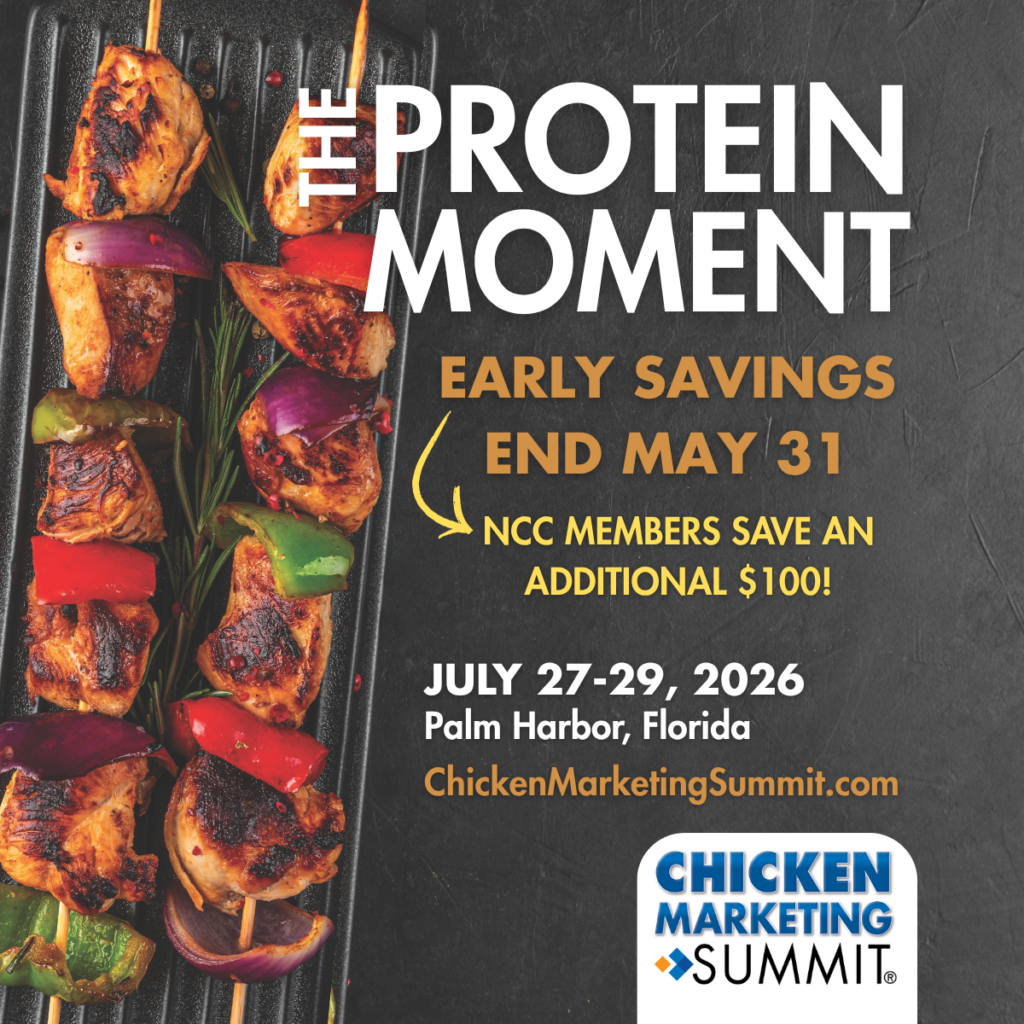
WHY IT MATTERS: The Chicken Marketing Summit is the premier annual conference for poultry marketing and sales executives, bringing together leaders from across the chicken supply chain — from processors and retailers to foodservice operators and allied industry partners. The event is produced by WATT Global Media in collaboration with NCC and remains a member benefit for NCC processor and allied member companies. NCC members also receive $100 off registration.
WHAT’S ON THE AGENDA: The 2026 Summit will center on the theme “The Protein Moment,” examining how protein-first eating trends, clean-label consumer preferences, and the rise of GLP-1 drugs are reshaping demand for chicken. The conference features 1.5 days of presentations, two evening receptions, and multiple networking opportunities. Confirmed speakers include Kevin Ryan of Malachite Strategy and Research on the GLP-1/high-protein consumer opportunity; Christine McCracken of Rabobank on forces reshaping the broiler industry; Erkin Peksoz of Circana presenting the annual Consumer Chicken Consumption Survey results; and Maeve Webster of Menu Matters on QSR innovation trends, among others.
BONUS INCENTIVE: Registrants before May 31 are automatically entered for a chance to win access to the VIP Hospitality Suite at the 2027 Valspar Championship, also held at Innisbrook Resort. The winner will be announced at the Summit in July.
WHAT’S NEXT: The early bird rate expires May 31. Retail grocery and foodservice executives qualify for complimentary registration with a refundable $150 deposit. The hotel room block at the group rate of $169 per night closes July 7. Register at cvent.me/OyKow8.