U.S. total broiler slaughter data for the week ending July 4, 2026, is estimated by USDA’s Poultry Market News Service to be 162,227,000 broilers, a 13-percent increase from the same week a year earlier.
The 13-percent increase in slaughter compares with a 2-percent increase in eggs set in the United States, 10 weeks earlier, and a 3-percent increase in chicks placed 7 weeks earlier in the United States. USDA’s latest Broiler Hatchery report can be viewed here.
| U.S. Eggs Set, Chicks Placed, Broiler Slaughter Report | ||||||||||
| Week ending | Eggs set | Chicks placed | Eggs set | Chicks placed | Broilers slaughtered | |||||
| change from | change from | 10 weeks previous | 7 weeks previous | |||||||
| 1 year | 1 year | 1 year | 1 year | 1 year | ||||||
| -000- | % | -000- | % | -000- | % | -000- | % | -000- | % | |
| May | ||||||||||
| 23* | 256,395 | 102 | 198,833 | 103 |
253,754 | 102 | 196,663 | 103 | 174,103 | 101 |
| 30 | 257,558 | 102 | 197,500 | 102 |
255,241 | 103 | 197,285 | 100 | 156,314 | 104 |
| Jun | ||||||||||
| 6 | 257,132 | 102 | 198,472 | 103 | 256,471 | 103 | 198,480 | 104 | 173,295 | 103 |
| 13 | 254,496 | 101 | 198,367 | 102 | 253,609 | 102 | 195,753 | 102 | 172,275 | 101 |
| 20 | 254,238 | 101 | 198,961 | 102 |
256,827 | 103 | 198,754 | 104 | 173,125 | 102 |
| 27 | 255,783 | 102 | 198,716 | 102 |
256,143 | 102 | 198,147 | 103 | 175,775 | 100 |
| Jul | ||||||||||
| 4** | 255,839 | 102 | 197,497 | 101 |
256,545 | 102 | 198,526 | 103 | 162,227 | 113 |
| 11 | — | — | — | — |
— | — | ||||
*Memorial Day Weekend
**July 4th Holiday Weekend
WHAT HAPPENED: House Agriculture Committee Chairman Glenn “GT” Thompson (R-Pa.) this week introduced the Securing Agriculture’s Workforce Act (SAWA), a bill to expand and modernize the H-2A agricultural guest worker program.
WHAT’S IN THE BILL: The legislation would remove the requirement that agricultural work be seasonal in nature, redefining “temporary” as any job contract of fewer than 350 days — opening H-2A access to year-round operations including dairy and poultry processing. The bill also revises the wage calculation methodology, caps year-over-year adverse effect wage rate (AEWR) fluctuations at no more than a 3.25 percent increase or 1.5 percent decrease, and mandates a single online platform to streamline interactions with the Departments of Labor, Homeland Security, and State.
WHY IT MATTERS: Most significantly for the chicken industry, SAWA expands the statutory definition of “agricultural labor or services” to include the harvest and processing of meat and poultry. Current H-2A rules exclude processing/harvesting because they fall outside the “agricultural labor” definition tied to seasonal field work. The bill covers only slaughter and the breakdown of carcasses, meaning the provision applies to front-end plant positions only. Further processing operations — deboning, portioning, marination, and ready-to-eat lines — remain outside the scope of H-2A eligibility under this bill. The bill also transfers authority to define “agricultural labor or services” from the Secretary of Labor to the Secretary of Agriculture.
NCC’S TAKE: “Work is not seasonal in our processing plants — it is year-round, so access to a pool of stable legal workers through a viable visa program is critical to food manufacturers, like chicken processors,” said NCC President Harrison Kircher. “We thank Chairman Thompson and look forward to working with him and Congress to pass this bill.”
WHAT THEY ARE SAYING: “There’s not a constituent in America, and a number of families around the world, that do not pick up the tools of agriculture an average of three times a day, knife, fork or spoon,” Thompson told reporters during a press conference on Tuesday addressing the bill. “Food security clearly is national security, and workforce is a main factor.”
WHAT’S NEXT: Because SAWA amends the Immigration and Nationality Act, it falls under the jurisdiction of the House Judiciary Committee, not the Agriculture Committee. Chairman Thompson has been working to build a broad coalition of original co-sponsors, and the bill has drawn support from more than 250 agriculture organizations. There is no companion bill in the Senate at this time. NCC will continue to engage with Congress on the legislation and advocate for provisions that support the chicken industry’s workforce needs.
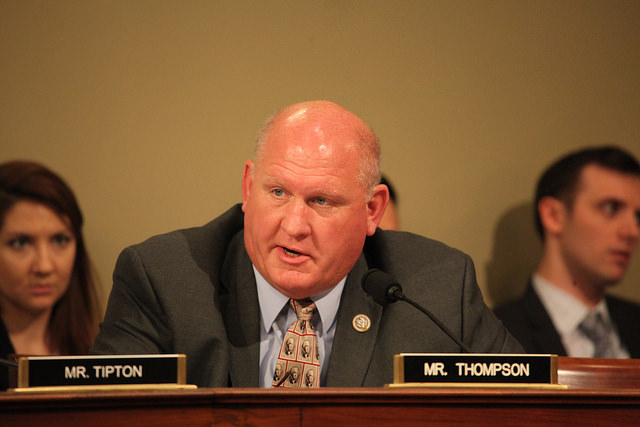
House Ag Committee Chairman GT Thompson. Source: House Ag Committee
WHAT HAPPENED: In its June 26 Constituent Update, FSIS announced a new pilot program allowing poultry processing establishments to test alternative approaches to managing Salmonella. The pilot is open to chicken and turkey slaughter and processing establishments subject to one or more existing Salmonella performance standards for carcasses, parts, or comminuted products.
WHAT IS BIOMAPPING? Biomapping is a facility-specific testing approach in which an establishment samples and tests multiple sites throughout its slaughter and processing operations — rather than relying solely on standard end-product testing points — to identify where and how Salmonella levels change as product moves through the facility.
WHO CAN PARTICIPATE: To participate, establishments must either incorporate Salmonella biomapping into their food safety system or include a validated Critical Control Point (CCP) for Salmonella control in their HACCP plan. Facilities that already conduct biomapping or have implemented a validated CCP are also eligible to participate.
WHAT ELSE IS IN THE PROGRAM: FSIS plans to evaluate a shortened moving window for Salmonella performance standards, moving from the current 52-week window to a variable window beginning at 13 weeks, with a maximum of 52 weeks. FSIS will also consider waiver requests submitted through the Salmonella Initiative Program (SIP) for alternative carcass microbial sampling frequencies.
Under the pilot, establishments using this option must submit a sampling plan identifying the specific locations where Salmonella samples will be collected and enumerated. The resulting data is intended to give both the establishment and FSIS a clearer picture of where contamination risk is concentrated, supporting more targeted interventions.
WHY IT MATTERS: Information gathered through the pilot could inform future regulatory changes and support updates regarding how the Agency evaluates and enforces Salmonella performance standards. The pilot program follows a public meeting held January 14 that discussed practical strategies for reducing Salmonella illnesses tied to poultry products, signaling continued agency focus on data-driven, plant-specific control strategies rather than one-size-fits-all standards.
NCC’s TAKE: We appreciate the Agency working with industry to collect data that will aid in making informed and science-based regulatory decisions.
WHAT’S NEXT: For establishments approved to participate in this pilot, FSIS inspection personnel will routinely verify collected biomapping data. Establishments opting to participate in the CCP pilot must submit information to FSIS describing the validated Salmonella intervention in their HACCP plan.

NCC features in a short spotlight column the official representative from each of our Allied Leader and Allied Member companies. This week’s Allied Leader Spotlight is Josh Gillespie, Vice President of Sales, at BAADER.
We asked Josh three questions:
In 2-3 sentences, describe what good or service your company provides to the broiler industry: BAADER is a global corporation, offering a portfolio of wall to wall of poultry processing solutions that aim to make food processing humane, hygienic, efficient, and safe. With the help of digitalization, we offer user-friendly software and monitoring systems that increase efficiency and waste reduction. We enable our customers to create plants of the future and set new standards in the food industry.
Briefly describe your position and responsibilities within the company: As VP of Sales in BAADER Food Systems USA Inc, I am responsible for all equipment sales within the US and Canada. With over 25 years of experience in poultry processing, I utilize my expertise, professional demeanor and strategic thinking to lead the sales force and spearhead new initiatives to further strengthen our market presence.
What is your favorite chicken dish: Marry Me Chicken – rich cheesy sauce, fresh herbs, pasta and of course the star of the show, Chicken.