NCC’s Washington Report will resume on Friday, June 19. We look forward to seeing many members next week in Jackson Hole for NCC’s Summer Board of Directors meeting! Safe travels!

WHAT HAPPENED: NCC this week filed comments with USDA’s Food Safety and Inspection Service (FSIS) in response to the agency’s proposal to revisit how it classifies meat and poultry establishments as “large,” “small,” or “very small.” NCC’s comments call on FSIS to amend the 30-year-old employee headcount method and replace it with a production volume-based system — and to add a new “medium” category to better reflect how the industry actually operates today.
WHY IT MATTERS: The way FSIS categorizes a plant affects everything from how new regulations are introduced to what resources and support a facility can access. The current system counts employees — a metric that made sense in 1996 but has become increasingly outdated as automation has enabled plants to produce far more with fewer workers. Under today’s rules, a highly automated facility and a small family operation can end up in the same “small” bucket, even though their scales, complexities, and regulatory needs may differ significantly.
WHAT NCC IS ASKING FOR: NCC recommended that FSIS use data it already collects — production volume in pounds per day — to build a new four-tier classification system tailored separately for each species (chicken, turkey, beef, pork, etc.). We also urged the agency to update those classifications at least annually so that plants are placed in the right category should their operations grow or change. For administrative purposes like grant eligibility or reduced inspection fees, we said revenue-based metrics can play a limited role — but shouldn’t be used for regulatory classification.
THE BOTTOM LINE: NCC supports FSIS taking a fresh look at this system and sees it as an opportunity to make oversight smarter and more efficient. Getting the classifications right means small plants get the support they need, and agency resources go where they’ll have the most impact on food safety.
WHAT HAPPENED: On the eve of World Hunger Day, Tuesday, a broad coalition of farmers, protein producers, hunger advocates, and government partners officially launched the Coalition to Close the Protein Gap — a $40 million public-private initiative aimed at permanently eliminating America’s annual 800-million-pound charitable protein shortfall. NCC is among the supporting organizations backing the effort, which is led by HATCH, the nation’s largest nonprofit focused on protein insecurity, and includes federal partners HHS and USDA. The goal: deliver up to 3 billion protein-rich meals to American families every year.
WHY IT MATTERS: Protein is the single most requested item in the charitable food system — yet it accounts for only 14 percent of food distributed through that system. The biggest obstacle isn’t supply; it’s the cold-chain infrastructure needed to move protein from farm to food bank reliably and at scale. This initiative pairs America’s existing agricultural capacity with the funding and logistics network to finally bridge that gap on a permanent, self-sustaining basis.
WHO’S INVOLVED: The coalition brings together a cross-section of the protein industry, including Cargill, Tyson Foods, Perdue Farms, Koch Foods, Case Farms, Mountaire Farms, Simmons Foods, and Wayne-Sanderson Farms, among others. Supporting organizations include NCC alongside the American Egg Board, National Cattlemen’s Beef Association, National Pork Producers Council, National Turkey Federation, and others. Tony Robbins, through his 100 Billion Meals Challenge, is serving as a public advocate for the effort.
HOW IT WORKS: Infrastructure and logistics will be managed by HATCH, which has spent a decade sourcing protein directly from U.S. farmers and delivering it through a cold-chain network to 120 food banks nationwide — without relying on ongoing donations. The $40 million in coalition funding will expand cold storage capacity and distribution infrastructure to operate at the scale needed to close the gap entirely.

WHAT HAPPENED: Registration is open for the 2026 Chicken Marketing Summit, scheduled for July 27-29 at Innisbrook Resort in Palm Harbor, Florida. But early bird rates — offering savings of $200 per registrant — end this Sunday on May 31.
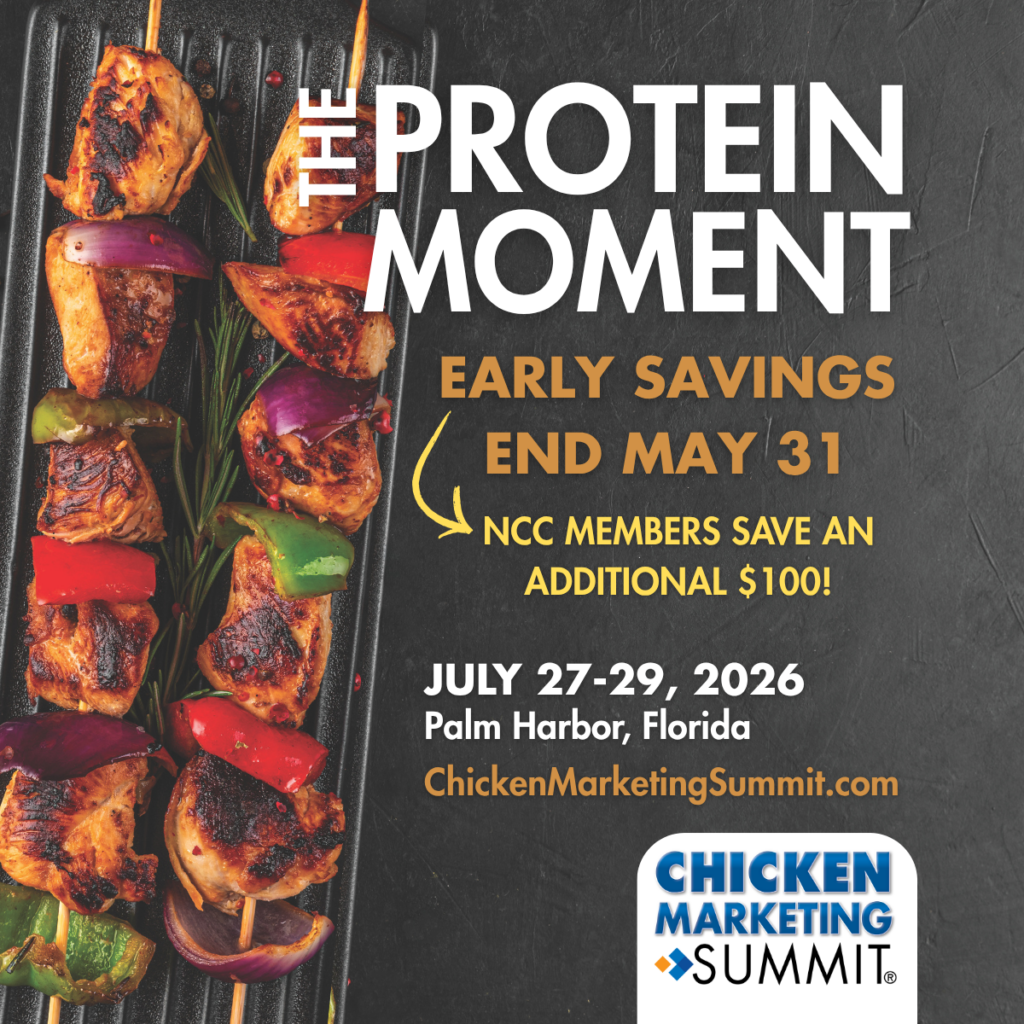
WHY IT MATTERS: The Chicken Marketing Summit is the premier annual conference for poultry marketing and sales executives, bringing together leaders from across the chicken supply chain — from processors and retailers to foodservice operators and allied industry partners. The event is produced by WATT Global Media in collaboration with NCC and remains a member benefit for NCC processor and allied member companies. NCC members also receive $100 off registration.
WHAT’S ON THE AGENDA: The 2026 Summit will center on the theme “The Protein Moment,” examining how protein-first eating trends, clean-label consumer preferences, and the rise of GLP-1 drugs are reshaping demand for chicken. The conference features 1.5 days of presentations, two evening receptions, and multiple networking opportunities. Confirmed speakers include Kevin Ryan of Malachite Strategy and Research on the GLP-1/high-protein consumer opportunity; Christine McCracken of Rabobank on forces reshaping the broiler industry; Erkin Peksoz of Circana presenting the annual Consumer Chicken Consumption Survey results; and Maeve Webster of Menu Matters on QSR innovation trends, among others.
BONUS INCENTIVE: Registrants before May 31 are automatically entered for a chance to win access to the VIP Hospitality Suite at the 2027 Valspar Championship, also held at Innisbrook Resort. The winner will be announced at the Summit in July.
WHAT’S NEXT: The early bird rate expires May 31. Retail grocery and foodservice executives qualify for complimentary registration with a refundable $150 deposit. The hotel room block at the group rate of $169 per night closes July 7. Register at cvent.me/OyKow8.

Senate Ag Chair John Boozman (R-Ark.) told Politico this week he thinks including hot rotisserie chicken in the SNAP program has a “good chance” of being included in the final farm bill. “It was very popular in the House,” said Boozman. “A lot of our members favor it, so we’ll have to wait and see.”
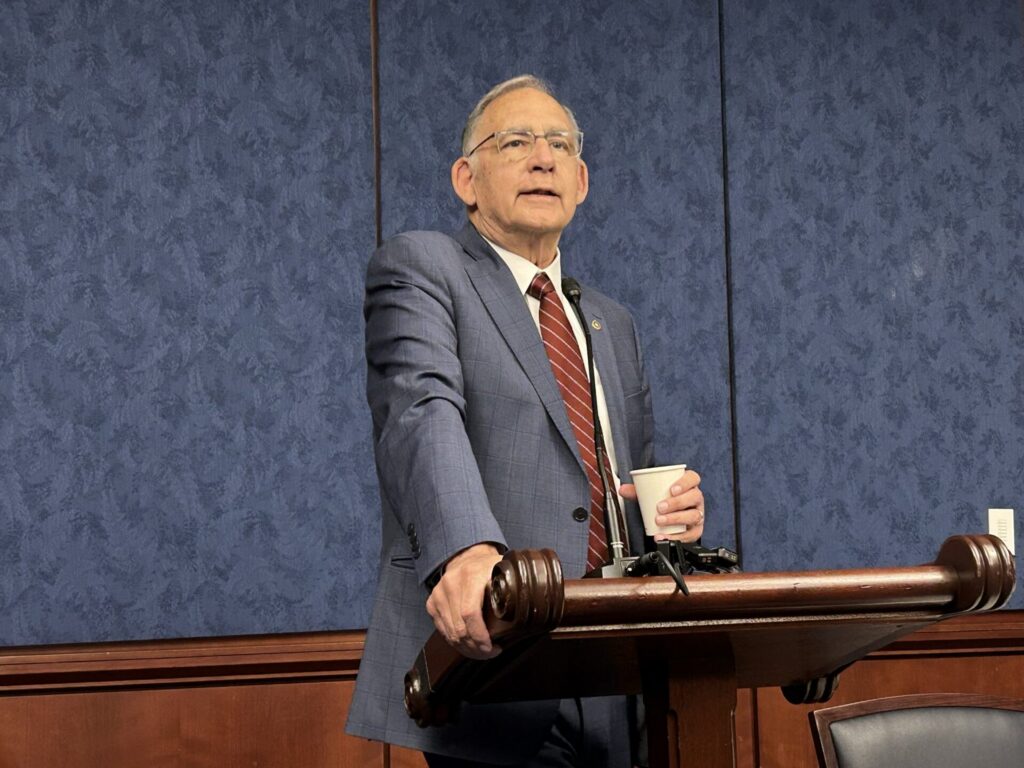
Senate Ag Committee Chairman John Boozman speaks with farm broadcasters at the NAFB’s 2026 Washington Watch (Photo by Brent Barnett/Brownfield)
Sen. Jim Justice (R-W.Va.), who co-sponsored the bipartisan Senate bill, said he’s pushing to include the language in the Senate farm bill. “Why in the world wouldn’t we want to have children and families to be able to have warm meals if we can?” Justice said. “And I just hope to goodness that we can secure it over here on this side.”
Senator Jim Justice (Official U.S. Senate photo by Ryan Donnell)