
Deputy Under Secretary Vaden, addressing the NCC Board in January
“Reducing ultra-processed food in schools doesn’t necessarily have to result from more scratch cooking. What it does mean is purchasing more whole food items and fewer items that have already been pre-seasoned or otherwise processed. More fruits and vegetables, more whole meats, fewer things like pizza and what have you, which may be popular on certain days — they certainly were when I was in elementary school — but aren’t necessarily the best for you.”
— Deputy Ag Secretary Stephen Vaden Tuesday at a Wall Street Journal Global Food Forum
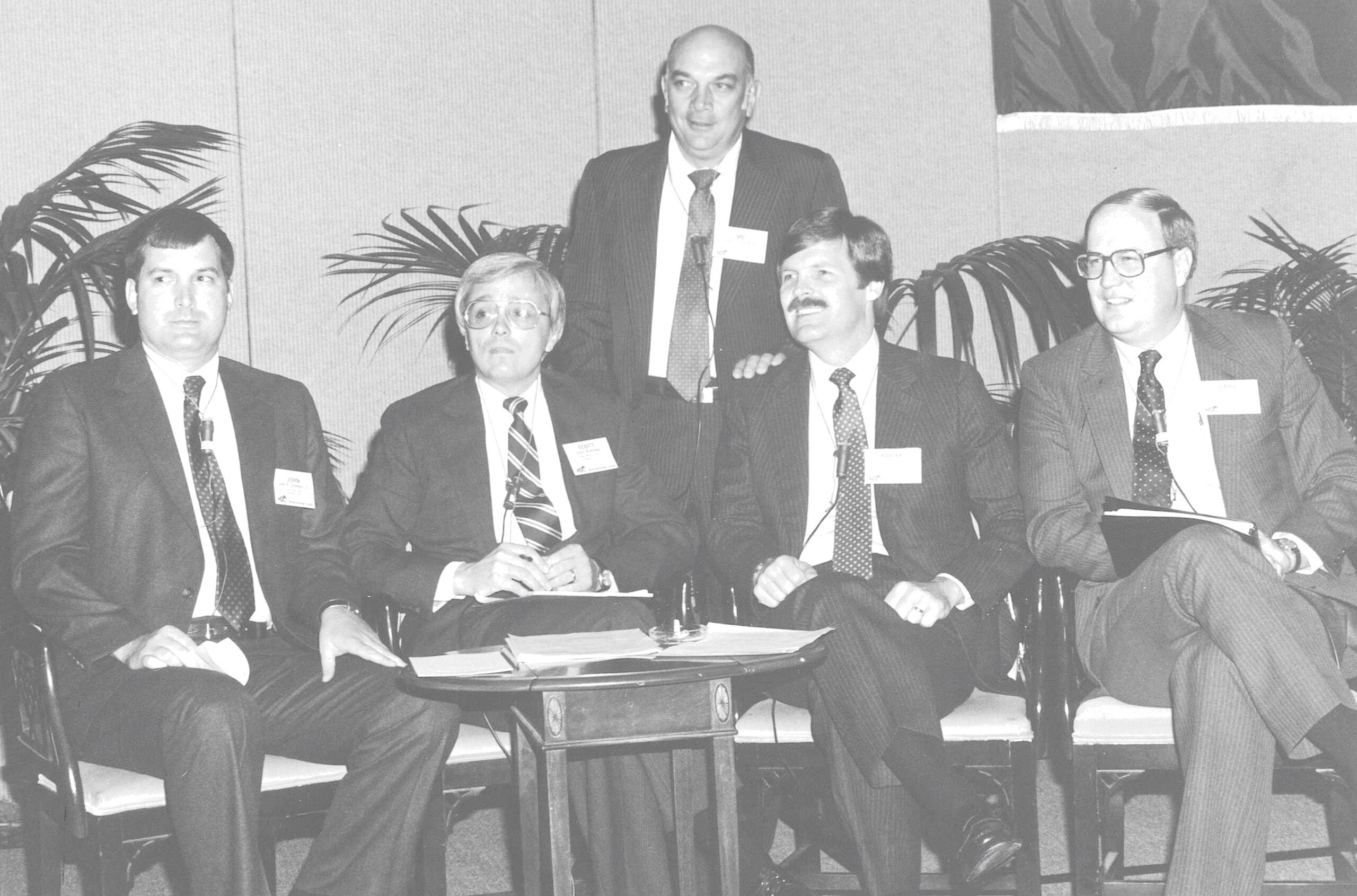
L-R: John Crowgey, Farm Credit Bank of Baltimore; Scott Andrews, Allied Bank of Texas; Victor Fontane, Corbett Enterprises; Roger Barr, Rabobank Netherlands; Carl Blackham, Bank of America. NCC Annual Conference 1984.
U.S. total broiler slaughter data for the week ending May 30, 2026, is estimated by USDA’s Poultry Market News Service to be 156,314,000 broilers, a 4-percent increase from the same week a year earlier.
The 4-percent increase in slaughter compares with a 3-percent increase in eggs set in the United States, 10 weeks earlier, and no change in chicks placed 7 weeks earlier in the United States. USDA’s latest Broiler Hatchery report can be viewed here.
| U.S. Eggs Set, Chicks Placed, Broiler Slaughter Report | ||||||||||
| Week ending | Eggs set | Chicks placed | Eggs set | Chicks placed | Broilers slaughtered | |||||
| change from | change from | 10 weeks previous | 7 weeks previous | |||||||
| 1 year | 1 year | 1 year | 1 year | 1 year | ||||||
| -000- | % | -000- | % | -000- | % | -000- | % | -000- | % | |
| Apr | ||||||||||
| 25 | 256,545 | 102 | 195,753 | 102 |
254,580 | 102 | 195,286 | 102 | 170,854 | 103 |
| May | ||||||||||
| 2 | 256,993 | 103 | 198,719 | 104 |
254,948 | 102 | 196,241 | 102 | 171,230 | 103 |
| 9 | 255,725 | 102 | 198,091 | 103 |
254,423 | 102 | 196,001 | 102 | 171,765 | 102 |
| 16 | 255,668 | 102 | 198,361 | 102 |
253,644 | 102 | 195,765 | 102 | 170,711 | 101 |
| 23* | 256,011 | 102 | 198,416 | 103 |
253,754 | 102 | 196,663 | 103 | 174,103 | 101 |
| 30 | 256,770 | 102 | 198,222 | 103 |
255,241 | 103 | 197,285 | 100 | 156,314 | 104 |
| Jun | ||||||||||
| 6 | — | — | — | — |
256,471 | 103 | 198,480 | 104 | — | — |
*Memorial Day Weekend
NCC’s Washington Report will resume on Friday, June 19. We look forward to seeing many members next week in Jackson Hole for NCC’s Summer Board of Directors meeting! Safe travels!

WHAT HAPPENED: NCC this week filed comments with USDA’s Food Safety and Inspection Service (FSIS) in response to the agency’s proposal to revisit how it classifies meat and poultry establishments as “large,” “small,” or “very small.” NCC’s comments call on FSIS to amend the 30-year-old employee headcount method and replace it with a production volume-based system — and to add a new “medium” category to better reflect how the industry actually operates today.
WHY IT MATTERS: The way FSIS categorizes a plant affects everything from how new regulations are introduced to what resources and support a facility can access. The current system counts employees — a metric that made sense in 1996 but has become increasingly outdated as automation has enabled plants to produce far more with fewer workers. Under today’s rules, a highly automated facility and a small family operation can end up in the same “small” bucket, even though their scales, complexities, and regulatory needs may differ significantly.
WHAT NCC IS ASKING FOR: NCC recommended that FSIS use data it already collects — production volume in pounds per day — to build a new four-tier classification system tailored separately for each species (chicken, turkey, beef, pork, etc.). We also urged the agency to update those classifications at least annually so that plants are placed in the right category should their operations grow or change. For administrative purposes like grant eligibility or reduced inspection fees, we said revenue-based metrics can play a limited role — but shouldn’t be used for regulatory classification.
THE BOTTOM LINE: NCC supports FSIS taking a fresh look at this system and sees it as an opportunity to make oversight smarter and more efficient. Getting the classifications right means small plants get the support they need, and agency resources go where they’ll have the most impact on food safety.